
Review: A Sorry State
About the welfare state, its trappings and those it leaves behind. By Jack Moyse
A Sorry State
By Jack Moyse
The Project Space, Ffotogallery, Cardiff
Collaborators: Menna Buss, Abby Poulson, Joshua Jones, GS Artists, 9to90 Creative Community, Oriel Sploj, Disability Arts Cymru.
—
Written by Sehna A. for Dyddiau Du Press
Sehna A. is a multidisciplinary artist and writer based in North Wales
—
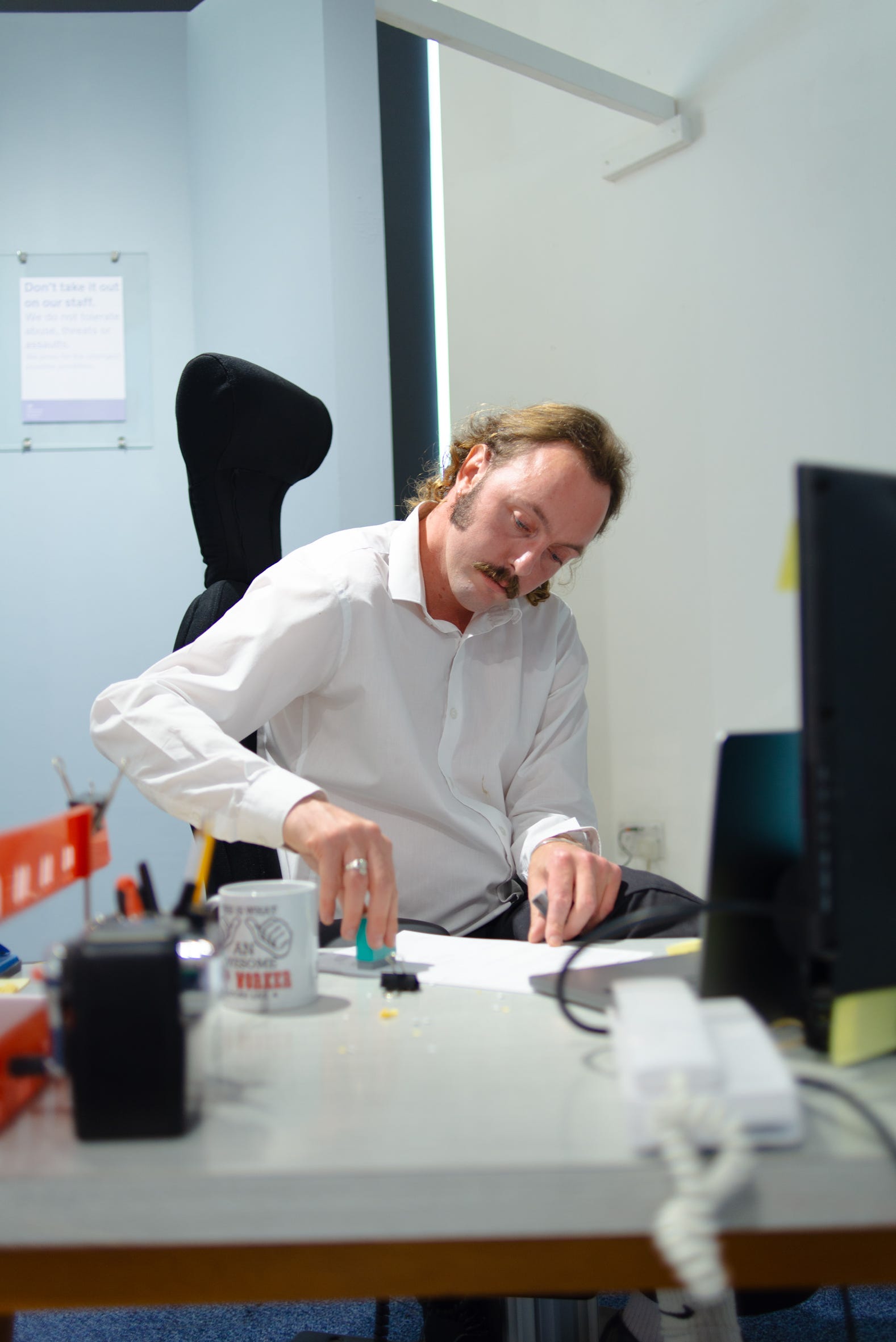
Are you able to open cans using the pull ring or a standard can opener?
Without the context of the usual forms, the question sounds almost absurd. It is one of several lifted directly from Personal Independence Payment (PIP) and Universal Credit (UC) evaluations and satirised in Jack Moyse’s A Sorry State.
Jack Moyse has long centred disabled lived experience in his practice. In A Sorry State, rather than simply documenting disability itself, gives material form to the bureaucracy that surrounds it. Working with his collaborators listed above, the exhibition brings together photography, installation, craft and testimonies into something resembling an institutional landscape, that interrogates the logic of the welfare state and exposes how it is experienced less as a single event than as an ongoing negotiation, shaping the lives of those required to navigate them.
Entering the space, the familiar neutrality of Ffotogallery disappears almost immediately. Blue office carpet interrupts the polished gallery floor, guiding visitors towards a reconstructed waiting room, complete with plastic chairs, a side table with readily available reading material, leading to a desk complete with Department for Work and Pensions (DWP) paperwork, assessment forms and office stationary. A novelty mug declaring, “This is what an awesome DWP worker looks like,” sits beside ominous “PASS” and “FAIL” stamps, while an overflowing shredder deposits administrative debris into the carpet.
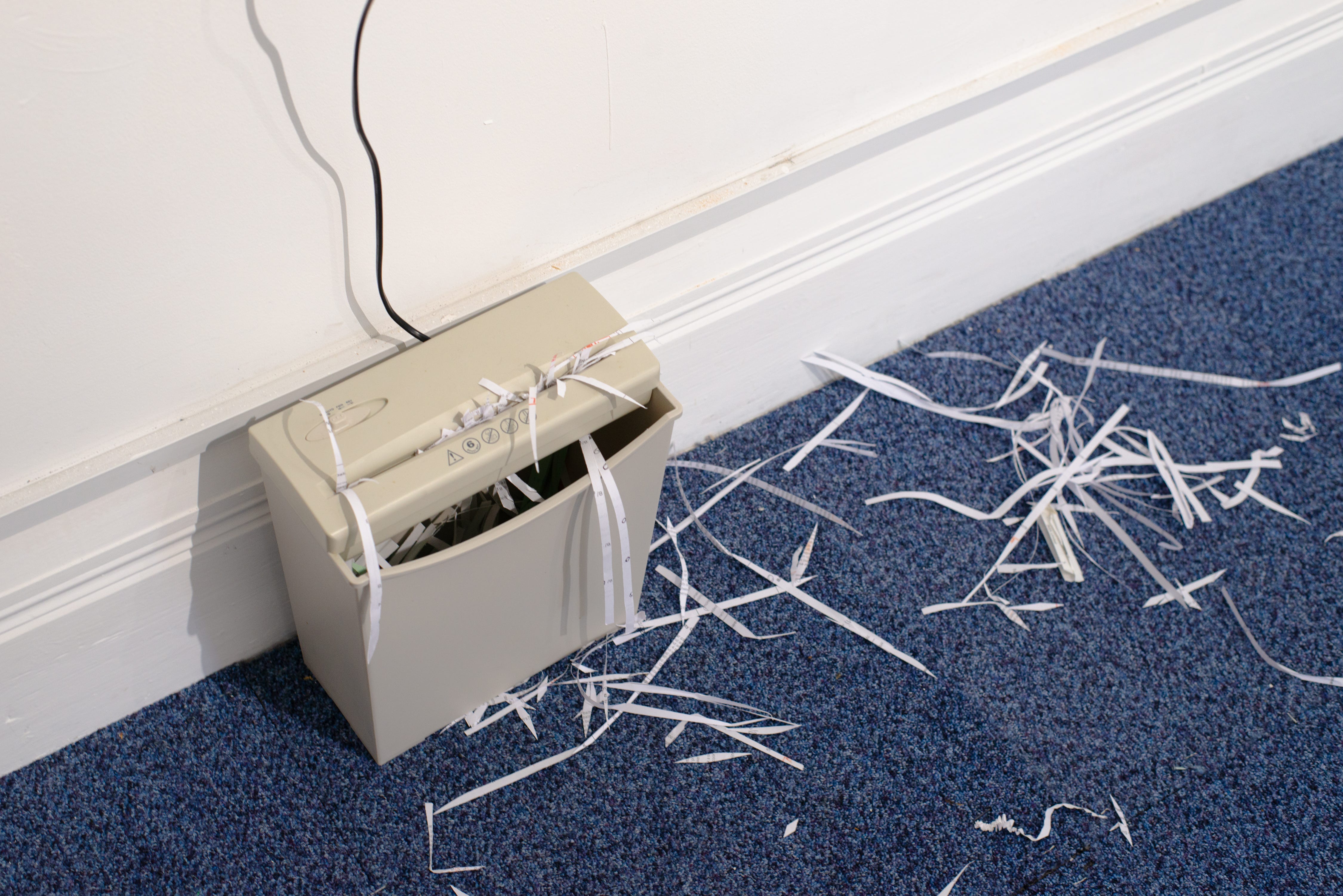
Waiting becomes the exhibition’s defining theme. The recreation of a government office does not simply parody the welfare system, but rather it reconstructs the peculiar suspension of time familiar to anyone navigating disability assessments in the UK. Since the introduction of increasingly stringent welfare reforms over the past few years, disabled people claiming UC and PIP have often found themselves caught within cycles of reassessment, tribunal hearings and repeated evidential demands. The exhibition comes as a recent review found that PIP is
“no longer fit for purpose and is failing to keep pace with how disability, health and work have changed over the past decade”
and that the process is “dehumanising”, “soul destroying”, “humiliating”, and “degrading”. The exhibition echoes these sentiments, allowing visitors to inhabit its rhythms.
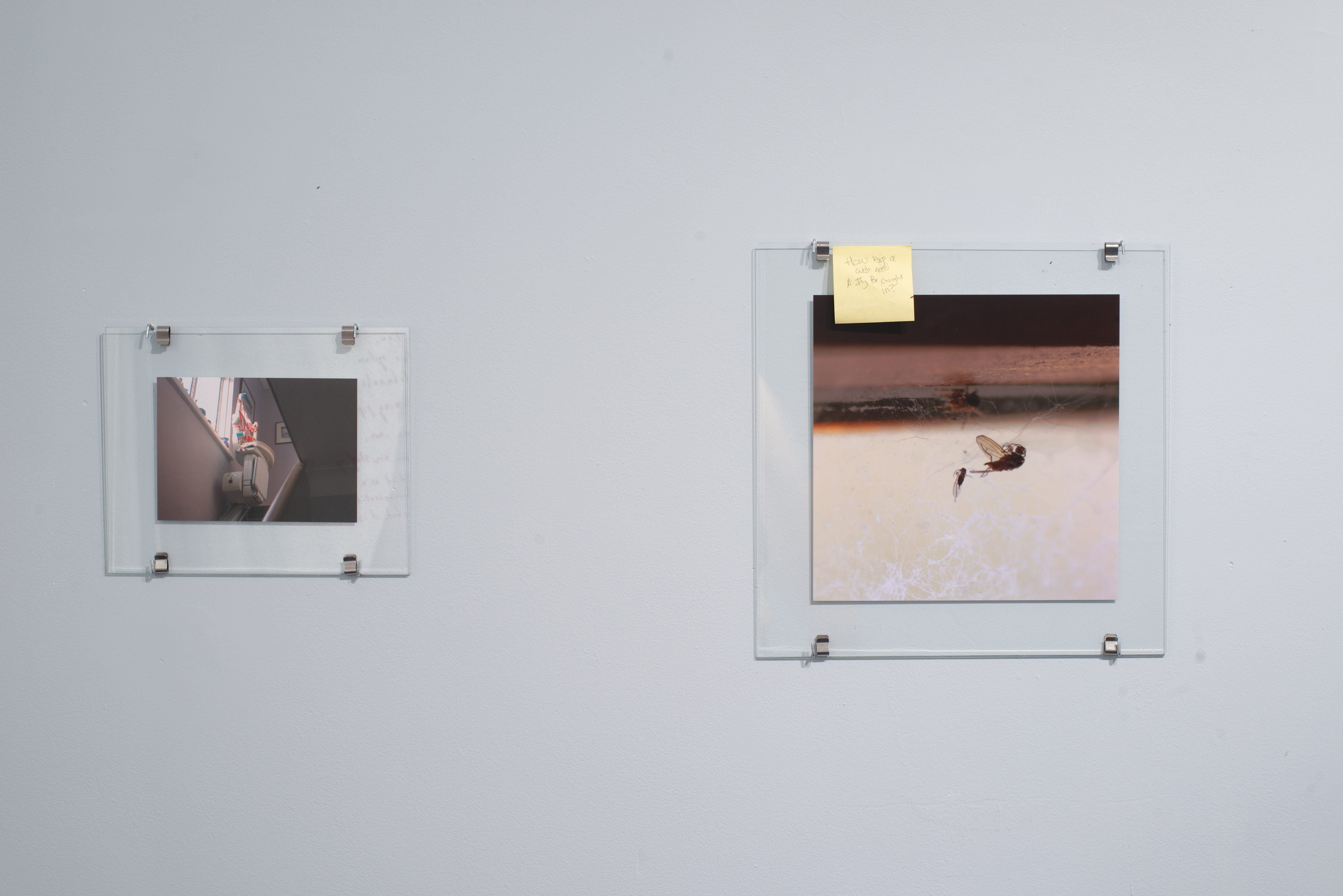
The lack of control extends to Moyse’s photography. His carefully staged still lifes framed within this staged office environment isolate everyday objects that these institutions cherry pick to evaluate the disabled experience. Medication, the piles of letters one could accumulate, a kitchen layout; the symbolic arrangements are photographed with an almost forensic clarity that recalls evidential photography more than fine art. In the welfare system, these items become evidence. Moyse’s still lifes exposes the strange transformation that occurs when private experiences become administrative evidence. Or as one sticky note summarizes, placed on a photograph of two flies caught in a spider web, “how big a web need a fly be caught in.”
A similar tension appears in Dear Angie… a specially commissioned text by Joshua Jones, clipped to the gallery wall with oversized bulldog clips. It reads somewhere between a personal letter, political manifesto and stream of consciousness. It repeatedly returns to the phrase “I decided…” each declaration reclaiming agency from a welfare system that persistently demands proof of incapacity with no guarantee of being accepted within the limitations of their web.
This staged office is complete with pamphlets that visitors can take home that are modelled on official DWP publications. At first glance they are almost indistinguishable from genuine government literature. Gradually, however, the language begins to slip. References to reducing support “to placate the disillusioned masses” expose the political assumptions often hidden beneath deceptively administrative neutrality. There is an understanding here that there isn’t a need for embellishment, the administrative voice already contains its own violence, requiring only slight adjustments before its ideological foundations become visible.
Small interventions throughout the exhibition further disrupt this official language. Post-It notes appear alongside photographs and office materials, offering alternative questions. One reads, “What’s a safety net? Why does it need to be falling into? What if we built up structures around people instead?” Its model of care might begin simply by changing the questions being asked.
A copy of Frances Ryan’s Crippled: Austerity and the Demonisation of Disabled People sits on the side table of the waiting room, perfectly arranged to sit down and have a read through. Ryan’s book contextualises the exhibition within the history of austerity politics. which reshaped public attitudes towards disabled people by presenting welfare recipients as figures of suspicion. A Sorry State gives physical form to this persistent argument. The heavily annotated forms and repeated assessments affirms how this suspicion becomes embedded within the everyday processes of welfare administration.


The emotional centre of A Sorry State is perhaps a quilt produced collaboratively with members of the 9to90 Creative Community and Menna Buss. It encompasses the collaborative methodology used to shape this exhibition. Bearing stitched testimonies from individuals who have spent years navigating the benefits system. What makes this quilt particularly significant is how they change the way these experiences can be encountered. Within the welfare system, personal testimony becomes evidence: something to be assessed, questioned and judged. While here, those same experiences become something to be held and shared. Access Guides assure visitors that they are invited to touch the quilt, sit with it or wrap themselves within it. After moving through a space defined by assessment and scrutiny, the invitation to rest becomes a quiet but powerful refusal of those conditions.
This approach extends throughout the exhibition’s approach to accessibility. Ffotogallery does not present access as an additional resource placed alongside the artwork, but as part of the exhibition’s ongoing development. The accompanying guide maps quiet spaces, nearby facilities and accessible routes while inviting visitors to comment on and reshape the gallery’s approach. Accessibility is understood not as a completed checklist but as a continuous and shared conversation.
A Sorry State is more than an exhibition about the failures of the welfare system; it’s method that reflects its argument. The people whose experiences shape the exhibition are not simply represented; their voices influence how the exhibition is made, encountered and understood. After reconstructing a space aestheticizing and satirising the established system, Moyse and Ffotogallery attempt to provide an alternative based on participation, care and responsiveness. By making visible the systems through which disabled people are repeatedly required to prove themselves, the exhibition demonstrates that bureaucracy is never abstract. It occupies spaces, bodies. and time. Shaping lives long after the paperwork has been completed.
If unsure of its urgency, one testimony stitched into the quilt in red cursive reads:
“I’ve been claiming benefits for the past 16 years. It is a punitive, dehumanising, and deeply unfair system. I have been through three tribunals in the 10 years I’ve been claiming pip. They don’t care how sick you are, how poor you are, how much you are struggling, or if you die. Hundreds have died as a result of this system. It is bureaucratic violence. No one believes it is this bad, it is.”
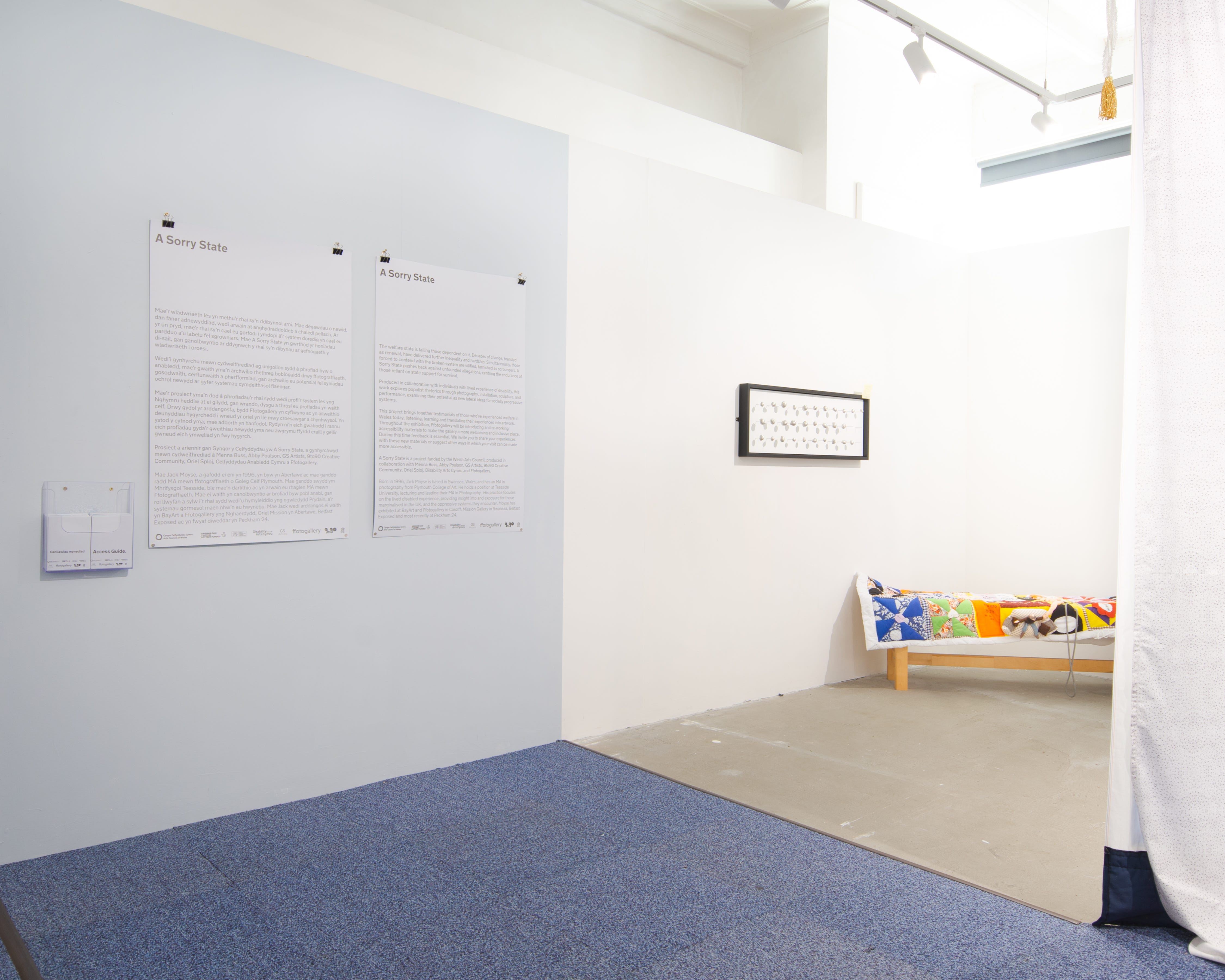
A Sorry State runs until Saturday 1st August 2026
Info about the show and the artist on Ffotogallery’s website here.
*Exhibition images courtesy of Jack Moyse
follow Jack on Instagram at @notabrothel
And check us out at @dyddiaudupress or www.dyddiaudupress.com
Is there an exhibition/art show in Wales you want to write about and want to be published by DDP? Send us your pitch!