The Hot Dog Show
Curated by Charlotte Grayland
BayArt, Cardiff
Exhibiting Artists: Brendan Lancaster, Carlota Sousa Nobrega, James Moore, Gavrick Sawyer, Louis Adams, Nik Hall, Sophie Lindsey, Máire Kennan, Mark Purves, Hotdog Hotdog, Harrisun Scott-Smith, Tommy Pang, João de Castro, Charlotte Grayland, Esyllt Angharad Lewis, Jamie Loftus
What does a sausage mean to an artist?
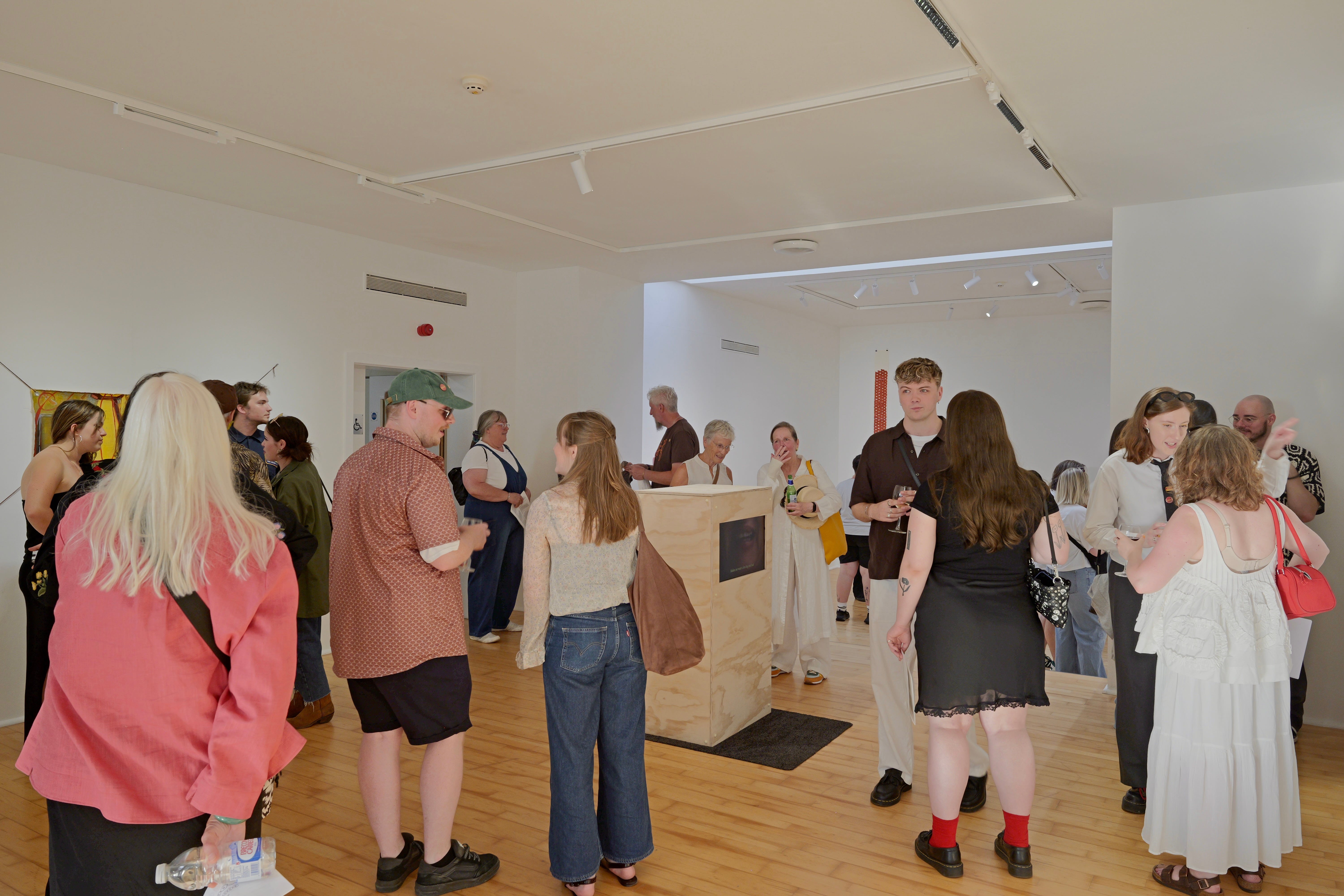
The Hot Dog Show, a group exhibition currently on view in BayArt, is a vibrant collision of answers to this seemingly frivolous question. Sixteen personalities meet for a feast, and the meals cooked and served are determined by each artist’s own type of hunger. Who would have thought that the versatility of a simple hot dog could be so astounding, its potential for meaning so broad. The works on show, vastly heterogeneous in nature, engage in incidental dialogues and dichotomies that expose the ripe symbolic power of a piece of... Of what, exactly?
A hot dog, a frankfurter, a sausage, a wiener: the most celebrated simulacrum of meat, a gooey beacon of globalised tradition. Its ubiquitous, egalitarian nature means that almost everyone, at some point, has had hot dog-infused thoughts and experiences. The Hot Dog Show invites us to unearth our subliminal associations with the good old sausage and confront them with completely unrestrained interpretations of the theme. Charlotte Grayland has curated a space brimming with deeply idiosyncratic takes on something superficially unserious, unsophisticated and oh-so-campy, yet there’s a whole universe hiding in plain sight. Nevertheless, the show doesn’t explicitly offer any coherent interpretative grid: its threads of meaning intertwine, tangle up and pull away while we, the guests in this peculiar restaurant, necessarily fill in the gaps between them with our own hot dog-shaped visions.
It seems that the familiar sausage can be, become or stand for anything you desire. In fact, desire itself (here understood within the scope of phallocentric eroticism) might be one of the lenses through which to consider the protagonist of this exhibition; after all, the phallic connotation between a wiener and, well, a wiener has always been prevalent in culture, its appeal exploited both creatively and strategically in equal measure. A hot dog as a phallic signifier is a pretext for transgressive explorations: it sets the scene for the push and pull between the sacred and the profane.
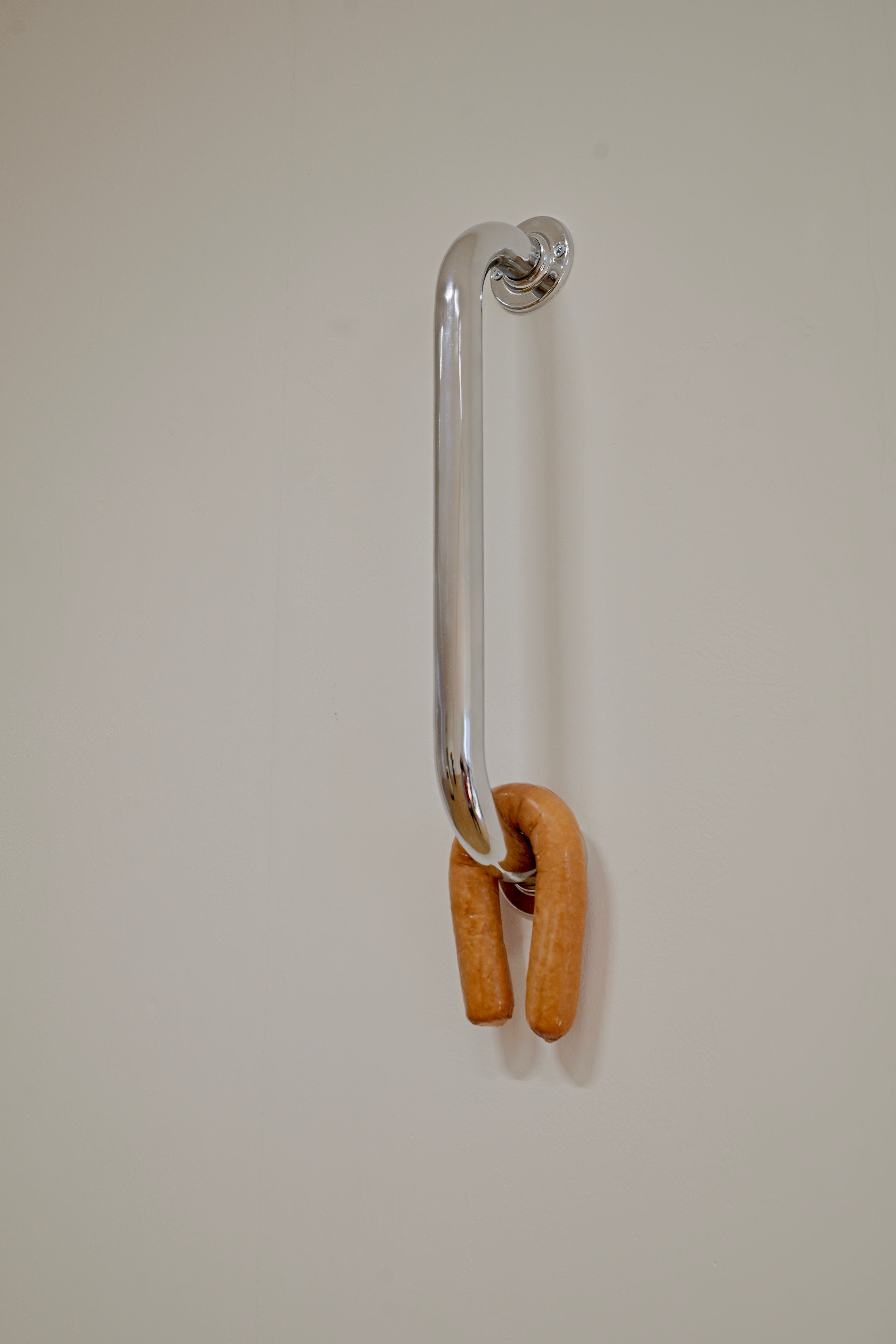
A disembodied, plump mouth trapped in a loop longs for a hot dog: “The mouth of the Lord” liberated from the patriarchal grip, its godly authority now mediated through the voluptuous, divine feminine (Charlotte Grayland, God Wants a Hot Dog, 2026). The artist frames this iconoclastic hunger as obsessive and insatiable: it’s trapped in an infinite loop, never to be heeded. Right next to it: a subversion of traditional iconography of crucifixion (Mark Purves, Moment of Crucifiction, 2023). A sausage hangs limply from a vertical, metal rail like an empty, forgotten horseshoe, its generous gifts now spent. A synecdoche of masculinity sustained by a handle (chrome, polished, almost sterile) that, somehow, feels more like a supporting structure than a torture device. Purves’s surrealist object echoes Louise Bourgeois’s ambivalent, fetishistic “castrated pieces of meat” that have been described as either objects of hate (when suspended from metal), or objects of love (when cradled).
In this context, Tommy Pang’s vibrant painting Pet Hot Dog (2026) seems to be the perfect counterforce to the limp, abandoned sausage, since it portrays the cradled object with cheerful precision while simultaneously subverting the familiar trope of Madonna and Child. Meanwhile, on the other end of the exhibition, Louis Adams investigates the symbolism of a glory hole whose name itself points to theological tropes: to the sacred that usually lies somewhere buried beneath the profane; to the glory achieved not despite but through transgression and, as suggested by the reference to Donald Judd, transformation (glory hole, red and yellow configuration [rested on donald judd, 1963], 2026).
The erotic, suggestive dimension of a hot dog inevitably invokes purely freudian tensions. While Harrisun Scott-Smith’s text examines the castration anxieties through a queer lens, using the horror genre as a vehicle to reify the symbolic and then fill it with the literal and gory (You’re The Wurst, 2026), Nik Hall’s use of emasculation iconography is virtually paradigmatic (Breaking Bread, 2026). Here, the scissors are about to, or merely threatening to, cut through a hot dog with almost clinical precision, while the first-person view makes us, the audience, not just complicit but actively involved in the procedure: the artist lends us her own hands so that we find ourselves directly occupying the role of the surgeon.
Although in a slightly different way, violence is also present in Gavrick Sawyer’s Вот он живой (2026), where the hot dog signifier borrows power and weight from the association with a Glock handgun (a “glizzy”) and by doing so strengthens its implications of control and dominance. The actual hot dog (by association also a “glizzy”) is deconstructed just to be artificially reassembled into an organised abstraction of shapes mirroring a gun’s extended magazine. So, in essence, it’s a glizzy fragmented by a glizzy and arranged into rows of glizzies. An ode to a fetish, perhaps. Meanwhile, inspired by Carol J. Adams’s book The Sexual Politics of Meat, Jamie Loftus takes the opposite stance and denounces the fetishising eye of patriarchy by linking fragmentation to speciesism, misogyny, and sexual violence (The Sensible Girl’s Guide to Becoming a Hot Dog, 2026). Traces of gender and class violence are also present in Esyllt Angharad Lewis’s poem beans are over (2026) where the tensions between the perceived and implied value of things stretch and compress the text’s own skeleton.
But what about an ode to nostalgia? What about pleasure and familiarity? Hot dogs can also be good vibes, I promise. For one, there’s great comfort in simplification, in extracting an essence from an idea. Brendan Lancaster’s painting Hot Dog (2026) is as straightforward as its title: an essence of a hot dog stripped of any excess or distractions, ready to be embellished with our own memories, associations, and histories. James Moore’s Raw Dog (2026) adds the playfulness of subverting the expectations and portraying something that’s steeped in nostalgic charm: candy. João de Castro’s nod to collective nostalgia can resonate deeply with anyone who grew up with a TV (To P.P., with Lorazelove, 2026), while Máire Kennan’s painting evokes the elusive nature of personal histories whose fragments, while not always easily identifiable, lodge themselves somewhere at the backs of our minds (National Pastime, 2026).
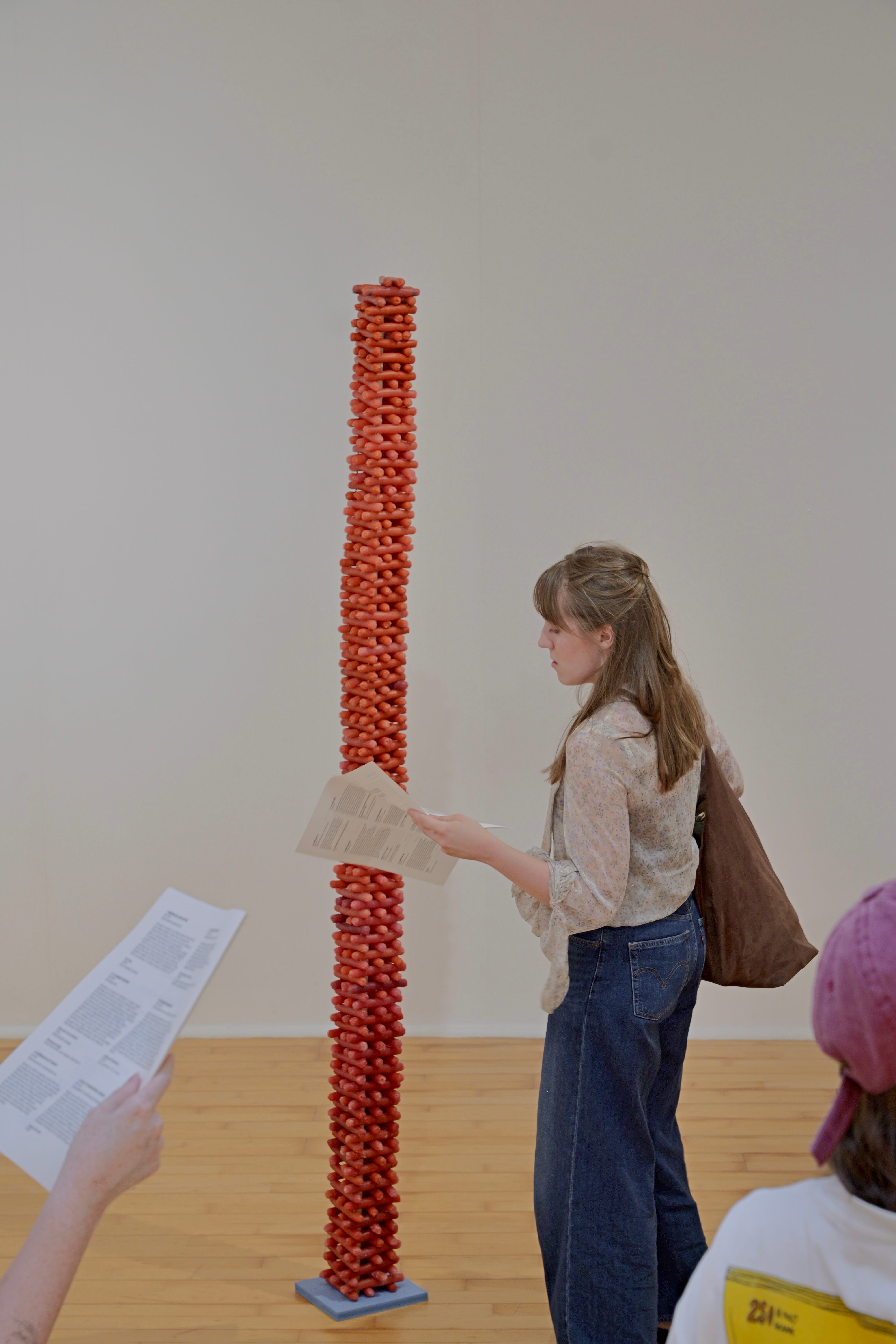
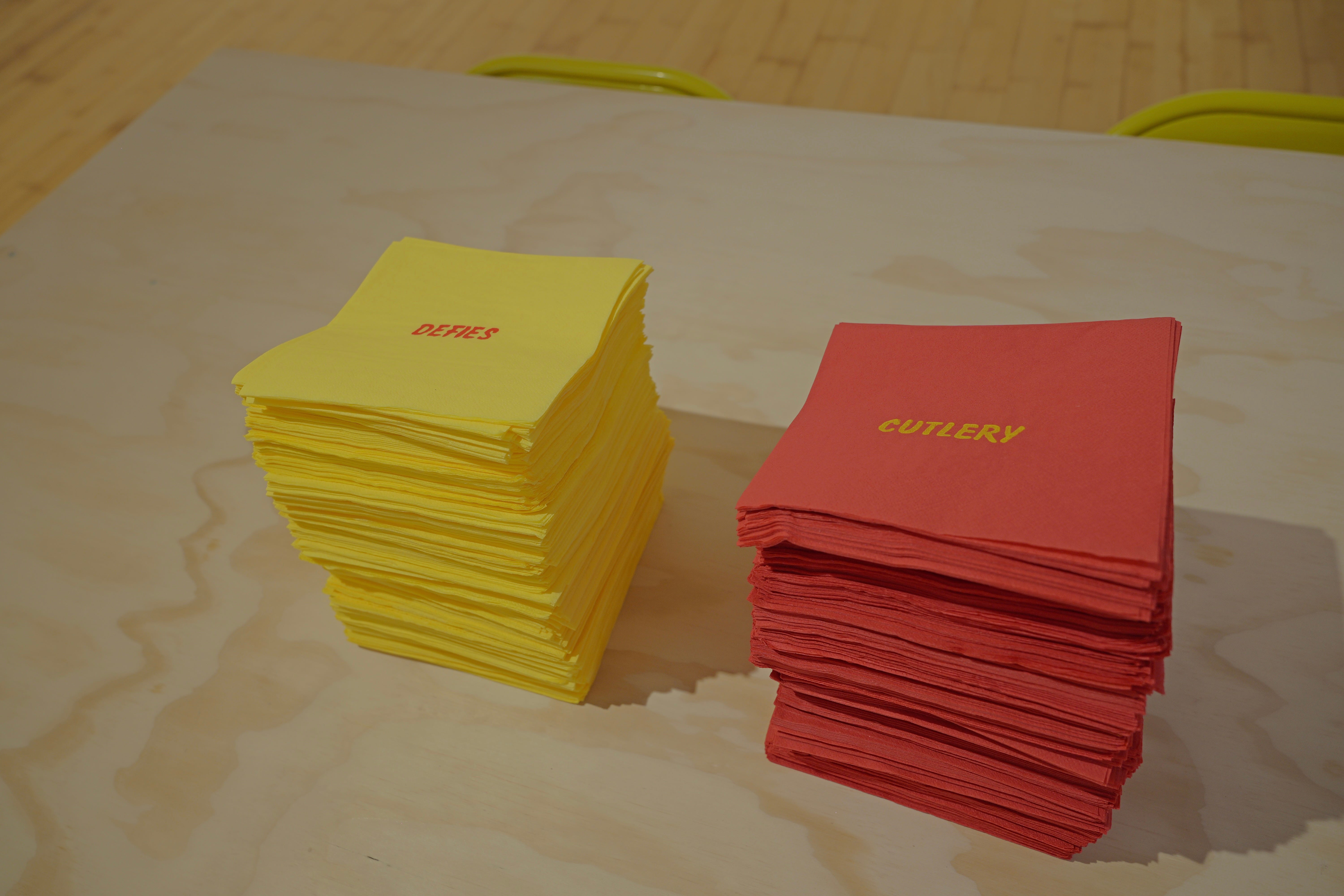
There’s also humour, of course. A simple hot dog lends itself perfectly as a vehicle for the absurd and the playful, be it in the form of The World’s Second Tallest Sausage Tower, a Jenga-like structure drawing its strength from nonsense (Carlota Sousa Nobrega, 2026), a psychedelic audio-video collage where hot dogs spin, whirl and fly around in a carnivalesque sequence that can cause vertigo (HOTDOG HOTDOG, Eat. Drink. Dance. Relish!, 2026), or a deconstructed breakfast embedded in a hot-dog-pulp-coloured styrofoam that smiles an unsettling smile (Mark Purves, Sausage and Egg, 2024). Or simple paper napkins that seem to exist somewhere between a clever joke and their intrinsic utilitarian value (Sophie Lindsey, Napkins [for hotdogs], 2026).
What does a sausage mean to a person? The Hot Dog Show is a charming pretext to do some hot dog-themed soul-searching: a little focused digging through the heaps of discarded, half-forgotten thoughts. After all, do you even know what a sausage means to you? Consider this a crucial question.
The Hot Dog Show runs until Saturday 8th August 2026
Info about the show and the artist on BayArt’s website here.
*Exhibition images courtesy of Charlotte Grayland & Declan Young.
Follow BayArt (and the exhibiting artists) on Instagram via @bayartcardiff
And check us out at @dyddiaudupress or www.dyddiaudupress.com!
Is there an exhibition/art show in Wales you want to write about and want to be published by DDP? Get in touch!
—
Written by Natalia Chirkowska for Dyddiau Du Press
Natalia Chirkowska is an artist, writer and art historian based in Cardiff. She’s currently working on a collection of short stories and her first graphic novel.
Natalia Chirkowska | @nkvka (Instagram)